
Weight loss is not only about seeing a smaller number on the scale.
It is also about feeling stronger when you climb the stairs. Moving more comfortably through your day. Protecting your joints. Building confidence in what your body can do.
That is why strength training and mobility are key parts of total wellness.
You do not need to start with heavy barbells or complicated workouts. You can begin with your bodyweight, a resistance band, or a pair of light dumbbells. You can start right where you are and build from there.
At Absofitly, we believe in becoming absofitly: nutritionally fit, physically fit, and mentally fit. Strength and mobility support all three.
Why Strength Training Supports Weight Loss
Strength training helps you build and maintain muscle as you work toward your weight loss goals.
Muscle gives your body support. It helps you perform daily activities with more ease. It also helps you feel capable and confident as you become more active.
When you lose weight, you want your progress to support a stronger, healthier body: not only a lower number.
Strength training may help you:
- Build lean muscle
- Support healthy body composition
- Improve balance and coordination
- Move with more confidence
- Make everyday activities feel easier
- Create a consistent fitness routine
You do not need to train like an athlete to see benefits. A few simple exercises performed consistently can help you start feeling stronger every day.
Why Mobility Matters, Too
Mobility is your ability to move your joints through a comfortable range of motion.
It is different from simply stretching. Mobility often combines controlled movement, strength, balance, and flexibility. It helps your body prepare for exercise and daily life.
Think about reaching overhead, stepping out of a car, bending to pick something up, or turning to look behind you. These movements require your hips, shoulders, spine, ankles, and other joints to work together.
Good mobility can help you:
- Move more comfortably
- Warm up before strength training
- Maintain better movement habits
- Support healthy joint function
- Improve exercise technique
- Feel less stiff after sitting or traveling
What is the goal? Not perfect flexibility. The goal is to move better and feel more at home in your body.

Start With the Four Basic Movement Patterns
A beginner workout does not need dozens of exercises.
Start by learning four useful movement patterns:
1. Squat
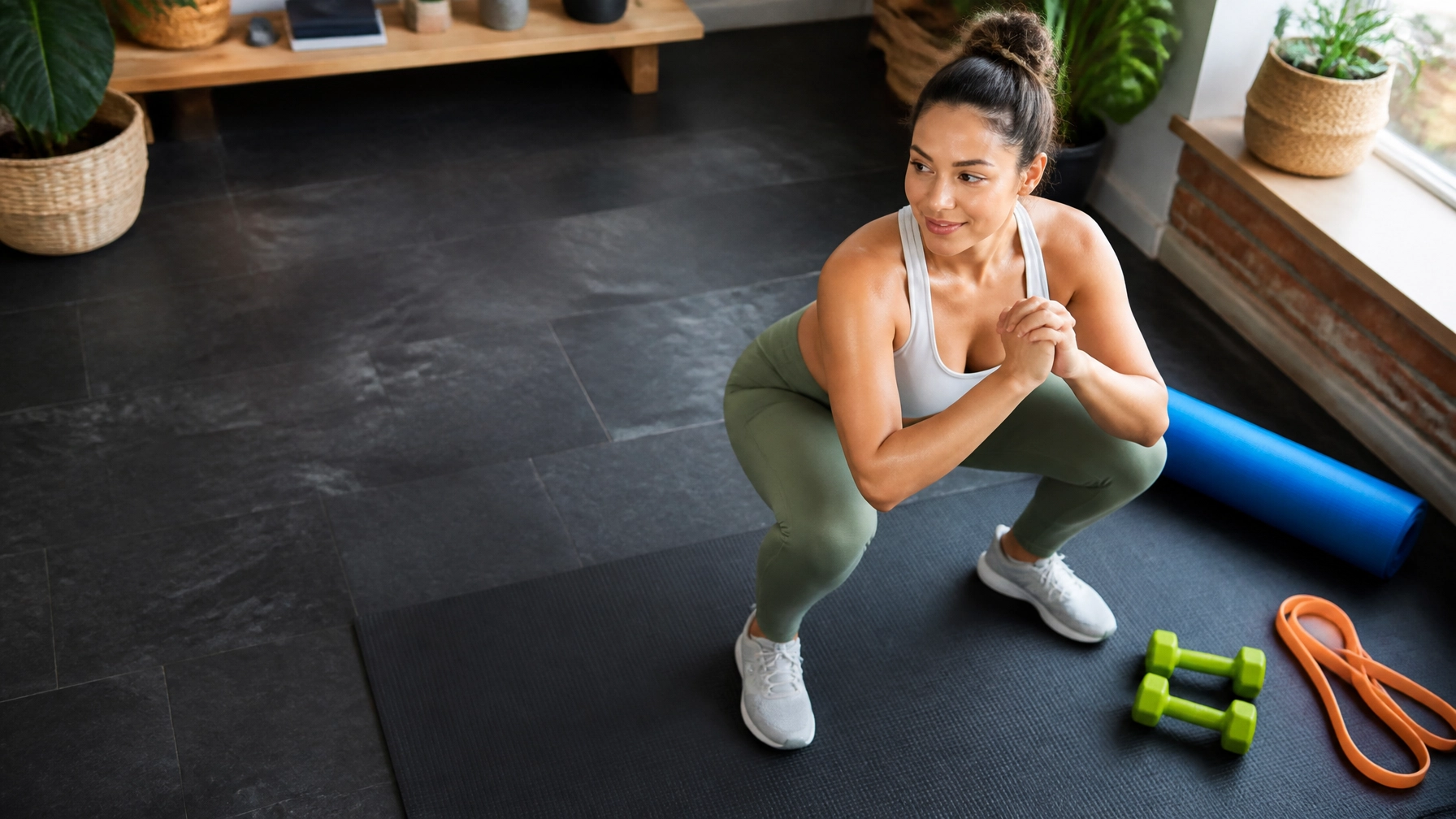
Squatting helps train your legs and hips.
Begin with a bodyweight squat. Stand with your feet about shoulder-width apart. Lower your hips slowly, as if sitting into a chair. Keep your chest lifted and stand tall.
If a full squat feels difficult, sit down to a chair and stand back up. This gives you support while you practice.
2. Push
Pushing exercises train your chest, shoulders, and arms.
Wall push-ups are a simple place to start. Place your hands on a wall, step back slightly, and lower your chest toward the wall. Press away with control.
As you get stronger, try an incline push-up with your hands on a sturdy bench or table.
3. Hinge
A hip hinge teaches you how to bend from your hips while keeping your back supported.
Stand tall with a soft bend in your knees. Push your hips back as if closing a car door with them. Keep your back long, then squeeze your glutes to return to standing.
You can later add light dumbbells or a resistance band for a beginner-friendly Romanian deadlift.
4. Pull
Pulling exercises train your upper back and arms.
A resistance band row is a practical option. Hold the band with both hands and pull your elbows back toward your sides. Keep your shoulders relaxed and squeeze your shoulder blades gently.
You can also perform a one-arm dumbbell row while supporting one hand on a bench or sturdy chair.
These patterns help create a balanced foundation. They train your body to push, pull, squat, hinge, stabilize, and move with purpose.
A Simple Beginner Strength Workout
Start with two or three full-body workouts each week. Give yourself at least one rest or lighter-activity day between strength sessions.
Try this routine:
- Chair squat: 1–2 sets of 8–12 repetitions
- Wall or incline push-up: 1–2 sets of 8–12 repetitions
- Bodyweight hip hinge: 1–2 sets of 8–12 repetitions
- Resistance band row: 1–2 sets of 8–12 repetitions
- Glute bridge: 1–2 sets of 10–15 repetitions
- Elevated plank: 1–2 sets of 15–30 seconds
Rest as needed between exercises.
Your first goal is not to finish as fast as possible. Your first goal is to learn the movements and complete them with control.
When the workout starts to feel easier, you can add a few repetitions, another set, a resistance band, or light dumbbells.

How to Choose Your Weights and Bands
Start lighter than you think.
Choose a weight that allows you to complete your repetitions with good form. The final few repetitions should feel challenging, but you should still feel in control.
You do not need to train until you cannot move. You also do not need to feel sore for the workout to count.
A useful beginner approach is to finish each set feeling like you could complete a few more repetitions if needed.
As your strength improves, progress slowly. You might:
- Add two or three repetitions
- Add one extra set
- Use a slightly stronger band
- Increase dumbbell weight a small amount
- Slow down the lowering part of the movement
- Improve your range of motion
Small improvements are still improvements. Stronger every day does not mean harder every day.
Warm Up for 5 to 10 Minutes
A warm-up prepares your body for movement.
Before strength training, spend five to ten minutes doing light cardio and dynamic mobility. You can march in place, walk briskly, or ride an easy stationary bike.
Then try:
- Arm circles
- Shoulder rolls
- Hip circles
- Gentle leg swings
- Cat-cow movements
- Ankle circles
- Easy bodyweight squats
Keep the movement comfortable. A warm-up should help you feel ready, not tired.
Mobility work can also be useful on its own. Try ten to fifteen minutes two or three times per week, especially on days when you are not strength training.

Your Simple Weekly Schedule
You can begin with a realistic weekly rhythm.
Monday
Full-body strength workout and a short warm-up.
Tuesday
Ten to fifteen minutes of mobility. Add an easy walk if it feels good.
Wednesday
Rest, light movement, or a relaxed walk.
Thursday
Full-body strength workout and a short warm-up.
Friday
Ten to fifteen minutes of mobility.
Saturday
Optional strength workout, longer walk, or enjoyable physical activity.
Sunday
Rest and prepare for the week ahead.
If three strength sessions feel like too much at first, begin with two. The best program is one you can continue.
You can also visit Absofitly’s Fitness group for more wellness support and explore the Training Guide for additional fitness resources.
Measure More Than the Scale
The scale is only one way to notice progress.
Pay attention to other signs, too:
- You can complete more repetitions
- You use a stronger resistance band
- Your balance feels better
- You walk farther without feeling as tired
- Stairs feel easier
- You can reach, bend, or squat more comfortably
- Your posture feels more natural
- You feel more confident starting a workout
- You recover better between sessions
These are meaningful wins.
Weight loss and wellness are not built in one perfect workout. They are built through repeated choices that support your nutritional, physical, and mental fitness.
Keep Your Joints and Body Supported
Strength training should feel purposeful, not painful.
Move slowly and stay within a comfortable range of motion. Muscle effort is normal. Sharp pain, sudden pain, or joint pain is a reason to stop and modify the movement.
Use a chair, wall, or bench when you need extra support. Begin with bodyweight before adding resistance. Give your body time to adapt.
If you have an injury, health condition, or concerns about starting exercise, speak with a qualified healthcare professional before beginning a new routine.
Become Absofitly, One Step at a Time
You do not have to be the strongest person in the room.
You only need to take the next helpful step.
Start with bodyweight basics. Add bands or light dumbbells when you are ready. Warm up your joints. Practice controlled movement. Build a routine that fits your life.
Whether you want to lose weight, get toned, move with less stiffness, or feel stronger in everyday life, strength and mobility can help support your journey.
Explore the Absofitly Weight Loss Program and discover a more complete approach to wellness.
Ready to get started with support that fits your goals?
GET YOUR FREE CONSULTATION TODAY and take your next step toward becoming absofitly: nutritionally fit, physically fit, and mentally fit.

0 Comments